
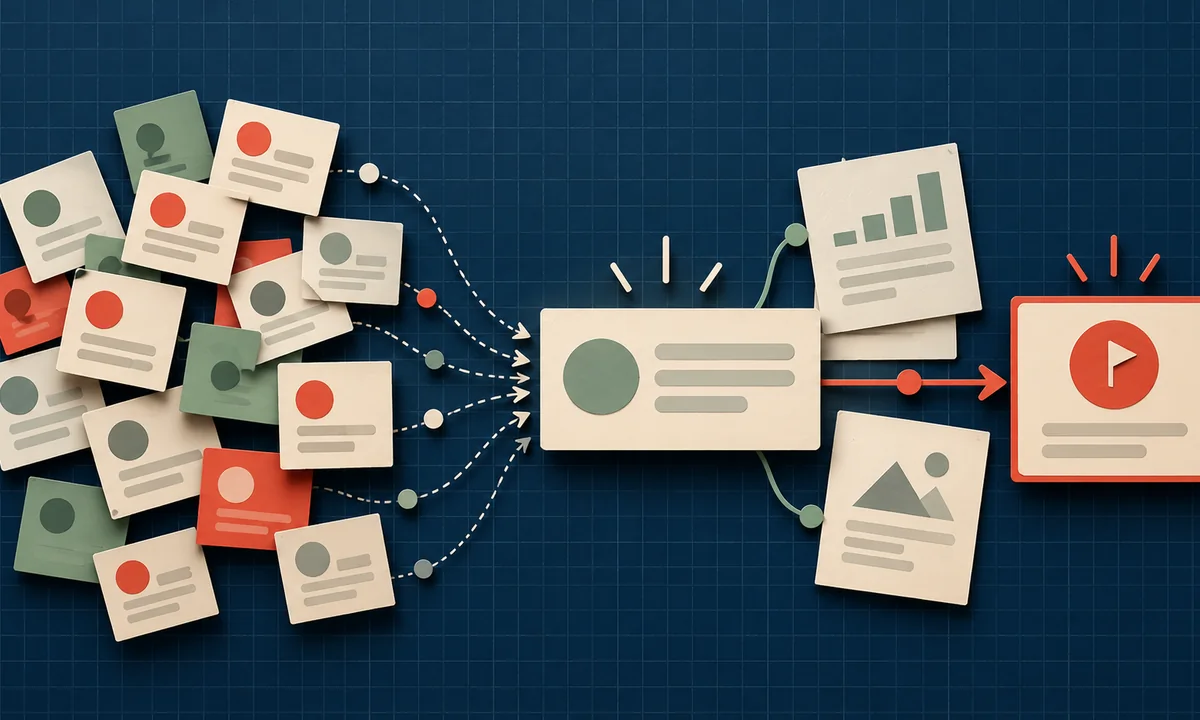
“Write an article about SEO” is not a brief. It is a category. A useful page begins with a question someone can answer, test, and act on.
AI search makes this distinction more visible because answer systems often summarize a page before a reader visits it. If your page offers only a vague introduction, there is little worth carrying into the summary—or clicking through to learn.
Find the question hiding inside the topic
Take “website speed.” It could mean “How do I measure speed?”, “Why is my product page slow on a phone?”, or “Which metric should my team improve first?” Those questions need different evidence and different next steps. Choose one primary question and list two or three follow-ups.
This is the same page-purpose work in our first website planning guide. A focused page can still link to a broad SEO hub and deeper guides. It does not need to answer every possible question in one screen.
Pew Research Center's study of 68,879 Google searches found that 60% of queries beginning with question words produced an AI summary. Only 8% of one- or two-word queries did, compared with 53% of queries containing ten or more words. This was a March 2025 US browsing sample, not a rule that every long query triggers AI. It suggests detailed questions deserve careful answer design.
Write the answer first, then earn the detail
Put a two- or three-sentence answer near the top. Name the condition under which it applies. Then explain the steps, evidence, trade-offs, and failure cases. For example: “Start with the mobile page and inspect the largest contentful element. If it is an oversized hero image, resize and prioritize that image before adding another cache plugin.” The reader gets a decision, not a slogan.
Avoid turning every heading into a question solely to chase a search feature. Headings should help someone scan the page. Use a table when comparison matters, numbered steps when order matters, and an example when a concept is easy to misunderstand.
Google's generative AI optimization guide emphasizes unique, useful content and existing search technical requirements. It does not promise an AI citation for a particular format. Indexing and snippet eligibility are prerequisites for its AI features, so technical SEO remains part of the job.
Add evidence with a visible boundary
If you say “most shoppers abandon carts,” name the source and define the population. Baymard's cart-abandonment tracker averages 50 studies at 70.22%. That number includes people browsing or comparing; it is not proof that a specific checkout is broken. A better article explains which part a store can act on and links to a focused checkout guide.
Keep a source note for each number: original URL, date, sample, definition, and last review. Our GEO source-trail guide shows the method. Link to original studies, standards, and official documentation where possible. If you run your own test, describe its setup and limitations instead of dressing it up as universal data.
Give readers a reason to continue
In Pew's study, users clicked a cited link inside an AI summary on only 1% of visits where a summary appeared. A concise answer can satisfy the quick question. The full page must offer something more: a worksheet, examples, data table, decision tree, or the exact implementation steps.
Finish with one appropriate next action. An article about speed can lead to a repeatable audit; one about ecommerce product pages can lead to a checkout map. Add internal links because they help the journey, not because a checklist says each post needs a fixed number.
Create a small answer brief before drafting: question, audience, direct answer, supporting evidence, likely objection, and next action. Give that brief to someone who has not worked on the topic. If they interpret the question differently, adjust it before writing 1,000 words. That early check prevents a polished article from solving the wrong problem.
Before publishing, ask an editor to read only the opening answer. Can they state what the page concludes and what evidence supports it? Then ask them to read the rest. Did it add depth? If the second answer is no, the page is still a summary, not an article. Use our AI search foundations guide to check the wider strategy.